
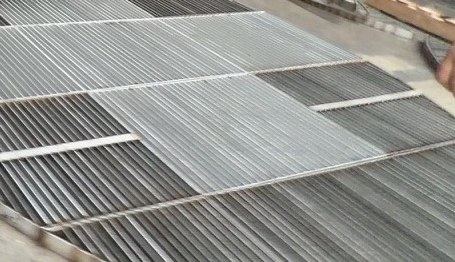
A vane mist eliminator – also called a chevron mist eliminator or vane pack – removes droplets carried with the gas at the top of a tower or scrubber, reducing product loss and protecting the compressor.
A pack of zigzag-shaped plates. The gas has to turn as it flows between them; the liquid drops cannot follow the turns, so they hit the plates and drain away.
Choose This Product When
- Liquid droplets leave the top of your tower with the gas
- You want to reduce the loss of valuable material
- You want to protect the compressor after the tower
- You need a plastic (PP) or metal unit
- Your gas carries large amounts of liquid
- Your gas contains solids or sticky material that could block a mesh pad
Plate Profiles and Designs
 C-type profile
 S-type profile
 Hemming type profile
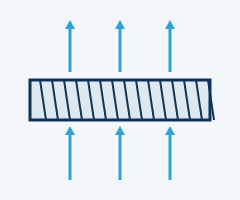 Flat design
 Roof design
Photos
Product Description
The vane mist eliminator separates droplets carried by the gas in a tower. It keeps mass transfer efficiency up, reduces the loss of valuable material and improves the operation of the compressor after the tower. It is usually installed at the top of the tower.
Vane mist eliminators are often used in wet scrubbers, where they stop the washing liquid from being carried over with the gas.
How It Works
The gas is forced through narrow, zigzag channels between profiled plates. At every bend the heavier droplets cannot turn with the gas, so they hit the plate surface, run together and drain away. Because the channels are open, vane units have low resistance and are less likely to block than a mesh pad.
Vane units are often combined with a mesh pad: the mesh catches fine droplets and makes them bigger, and the vanes then remove them at a higher gas velocity.
Features
- PP and metal types
- Plate profiles: C-type, S-type and customised hemming type
- Six designs for different installations
Applications
- Towers (installed at the top)
- Flue gas
- Gas scrubbers and knock-out drums
- Horizontal gas flow in ducts
Often Used in These Industries
Types Available
- Flat mist eliminator
- Roof type mist eliminator
- Pipe mist eliminator
- Flue mist eliminator
- S-type mist eliminator (water collector)
- High efficiency mist eliminator
Materials
- Polypropylene (PP)
- Metal
Frequently Asked Questions
What types of mist eliminator are there?
The two main types are wire mesh pads, which catch fine mist, and vane (chevron) packs, which handle high liquid loads and dirty gas. They can also be combined in one vessel.
When is a vane mist eliminator better than a mesh pad?
When the liquid load is high, when the gas contains solids that could clog a mesh pad, or when a low pressure drop is important.
Which materials are available?
Polypropylene (PP) and metal. The material is chosen for your temperature and chemicals.
Can vanes be combined with a mesh pad?
Yes. A mesh pad and a vane pack are often combined, so both fine mist and high liquid loads are handled.
Related Products
All Mist & Liquid Separation →Wire Mesh Demister Pads
Knitted mesh pad that catches mist in gas
Oil-Water Coalescers
Removes water droplets from oil
Three-Phase Separator Internals
Splits a stream into gas, oil and water